
 This blog post is written by guest contributor Laura Gardner. Laura’s bio can be found at the end of this post.
It’s our favorite time of year – Back to School! As you begin to work with your English Learner students, please don’t forget about engaging their parents. Numerous studies have shown just how important family engagement is and the positive impact it has on student achievement. I would argue it’s even more important for our newcomer families as they learn how we “do school” in America. Here are three tips for building relationships with newcomer parents as you start off the school year.
The most important thing any teacher or school personnel can do is to make ALL  families feel welcome regardless of what country they’re from, what language they speak, and so on. Regardless of one’s feelings on the immigration debate, it is important that we check our politics at the door. So smile! Greet parents as you would want to be greeted, even if there is a language barrier. Feelings can easily be conveyed through body-language so smile and say hello! Even better – learn a simple greeting in another language or two.
 The second most important thing teachers and other school personnel can do is to provide newcomer parents with some kind of orientation. There are so many things that seem obvious to us, but could be new to some families. For example, school busses are yellow. Families may not know these sorts of things, so explain everything! Be sure to also explain expectations around parent involvement because in many countries, this expectation or practice doesn’t exist. In fact, in many countries it is considered disrespectful if a parent visits their child’s school because it is seen as challenging authority. Orientations may be delivered in person or by video (for an example, click here).
A third necessary component to building relationships with newcomer families is interpretation and translation services. If your district has interpretation and translation services in place, please use them! It is not up to you to decide whether a parent needs the language assistance or not – it’s the parent’s decision and their right. If your district does not have interpretation and translation services in place, please do not use students to interpret! This will be tempting to do, but students often do not have the vocabulary needed in both languages, nor have they been trained as interpreters. Furthermore, it puts them in a position of power with access to information they normally wouldn’t have access to. A second word of caution: do not use Google translate! This will also be tempting to do, but machine translation is far from perfect and can sometimes cause more problems than good. A colleague of mine once tried using it for a poster that said “bully free school” and Google translated to “school without killers.”
So if your district doesn’t have interpretation services, what should you do? 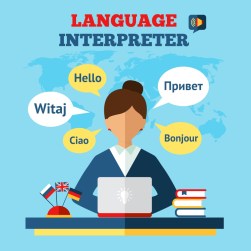 Probably the most reasonable temporary fix is to see if any parents or bilingual community members can volunteer their services. However, please note this really should just be temporary solution because anyone interpreting in a school setting really needs to have their language skills assessed and needs to be trained. Just because an individual speaks two languages does NOT mean they know how to interpret. Interpreting is a skill set of its own that requires practice! Furthermore, language volunteers should go through whatever procedure is typically used to screen volunteers and to ensure confidentiality.
If you’re encountering language barriers with parents and do not have access to interpretation services, the most important thing you can do is speak with your principal and someone at your school district’s central office about the need for these services and share this fact sheet from the U.S. Department of Education. It explains the federal laws around providing parents with information in a language they understand.

So there you have it. Be welcoming, provide orientation, and provide interpreters! Those are three suggestions to get you started for this school year. Be on the lookout for a new online course on “Immigrant Family & Community Engagement” in the English Learner Portal Online Classroom. It’s coming soon!
Please note: Welcoming America is sponsoring “Welcoming Week” September 15-24 and also just released a “Building Welcoming Schools” guide. Check it out!
^^^^^^^^^^^^^^^^^^^^^^^^^^^^^^^^^^^^^^^^^^^^^^^^^
Laura Gardner has 16 years of experience working in public education (MD & VA), refugee resettlement, and social work. While in public education, she worked as a district level manager for immigrant family and community engagement as well as a school social worker. Prior to working in the schools, Laura worked for Bridging Refugee Youth and Children’s Services (BRYCS) and managed their national technical assistance initiative to federal Refugee School Impact Grantees. Laura has facilitated trainings on building the capacity of teachers and school systems to engage immigrant families in their children’s education, language access, cultural competency, equity, unaccompanied immigrant children, immigrant family reunification, and refugee resettlement. Laura holds a Master’s degree in Social Work from Columbia University and a Bachelor’s degree in Education.
COMING SOON to the English Learner Portal Online Classroom – “Immigrant Family and Community Engagement” online course.
Sign up for our newsletter here!

 to welcome newcomer English learners as they would any new student, and that sharing a smile or just saying “Hi!” is a good start. Teach your students a few strategies for helping. For example, share that they can point out important papers, words, images, etc. to new students. Encourage your students to invite Newcomers to join in and talk to them even if they don’t understand. Try a few activities like charades that show how much can be communicated without words. It’s the thought that counts!
 Have visuals and labels posted around your classroom and during instruction. Write important words and phrases on the board AS you talk. Incorporating pictures, manipulatives, multi-media presentations, videos, etc. will make content more understandable to a Newcomer, even though he may not know English. Point to visuals and labels as you speak, to help students make connections between the spoken words and objects. This approach will also be appreciated by non-English learner students who are visual learners.
 acceptable to have students who speak the Newcomer’s language translate from time to time, especially the first day, to help the student acclimate. HOWEVER, it is important that you first ask the veteran student’s permission, and if he or she really wants to be a translator. Some students may be embarrassed or feel uncomfortable speaking a foreign language in front of their peers. The goal of the student translator is not to be a one-on-one interpreting service, but rather to serve as a resource during the first difficult days in your Newcomer’s new classroom.


 people think of them and what they need. Partners were focused on creating the loudest machines possible with their STEM kits. (OK, the goal was to learn about circuits and create a machine that worked, but they were LOUD.) Students had four full days of escaping the pressures of the neighborhood and building relationships that will support them into the school year.
 and many among us, continue to work tirelessly day after day with an open heart: just being there, showing concern, being available, giving students a means and a place to express themselves.
 I had planned to spend a chunk of my summer giving English Learner Portal a greater web and social media presence. Get the website up (
 Our first book study will be “Boosting Achievement – Reaching Students with Interrupted and Minimal Education” by Carol Salva and Anna Matis. I ordered this book a few months ago after seeing it on Twitter. I know many programs and teachers struggle with reaching our students who come to us with little English and little formal education, especially those who are coming to us as teenagers and young adults. I thought the book was very easy to read and provided a good mix of research and practical examples that I could implement tomorrow. I reached out to Carol and, to my surprise, she gave her full permission and excitement to create the online book study!
 englishlearnerportal.blog