

Today’s blog is written by Laura Gardner. Laura has 16 years of experience working in public education, refugee resettlement, and social work. While in public education, she worked as a district level manager for immigrant family and community engagement as well as a school social worker. Learn more about Laura on our English Learner Portal website.
20 Ways to Increase Equity through Family Engagement with English Learners & Immigrants by Laura Gardner
Making international families feel welcome and included in your school is crucial to building success for students. Not only can you increase family engagement through language access, it is also a legal responsibility. What does your school system offer? How can you raise the bar for your school and classroom? Take a look at the tips below!
At the school level
 Translate your parent newsletter – and all information going home to parents! – into the major languages of your school community. This includes information about field trips, after-school programs, and extra-curricular activities.
- Make sure non-English speaking parents know it’s their right to ask for an interpreter when they’d like one and that they know how to request one.
- Offer English Learner and immigrant parents an orientation workshop (or video) in their language with information about your school and how to get involved.
- Talk to English Learner and immigrant parents about the concept of “parent involvement” in the U.S. and expectations around it. Make sure parents understand it is not disrespectful for them to visit school and/or ask the teacher questions.
- Make sure signage is translated by the front door of the school and in the front office.
- Translate report card comments or have a mechanism in place for parents to call and get oral assistance understanding the comments.
- Consider overhauling how you do Back to School Night or Open House to make it more accessible and less confusing for all Advocate for as many interpreters as you need.
- Balance the family events in your school in such a way that some events are 1.) for all parents (with interpretation provided for parents needing it) and other events are 2.) just for English Learner / immigrant parents (typically funded by Title III) so that they can hear the information in their language and topics can be specifically geared towards immigrants.
- Make sure your parent events or opportunities are linked to students’ learning! For example, potlucks are nice, but why not choose a high-impact family engagement strategy? (Check out our online course on immigrant family engagement for loads of ideas.)
- Advocate, advocate, advocate for immigrant families’ needs. But don’t only advocate for the Spanish-speakers!
At the district level:

- Make sure your legal office is aware of all federal, state, and local language access laws.
- Make sure interpretation and translation services are budgeted for! Do not rely on Title III for all needs. Be aware of “supplement vs. supplant.”
- Consider having a language access committee or task force that includes staff from multiple offices such as communications, ESOL/English Learners, and family engagement. That said, no matter the size of the district, make sure there is at least one person at the central office who is ultimately responsible for language access.
- Provide multilingual outreach for all district-wide invitations to events or activities. Never attempt to document the need for interpretation services at a particular event unless the outreach for such event was translated.
- Make sure all information going home to parents from the central office is translated into the district’s most dominant languages. This includes information about any gifted and talented programs, magnet programs, and any other accelerated programming. This also includes information about the budget and any opportunities to weigh in on the budget.
- Make sure all robo-calls and/or text messages are sent out in the major languages of
 the community, particularly for emergency situations.
 - Make sure the district has a contract with a phone interpretation system. It is the cheapest and most convenient form of instantaneous language access there is.
- Provide training for staff on language access laws and how to work with interpreters.
- Provide simultaneous interpretation for school board meetings (via headsets and equipment), particularly for opportunities for public comment.
- Don’t forget about all of the language backgrounds besides Spanish! While it may not be legally required and/or cost efficient to create written translations for smaller language groups, be sure to have other mechanisms in place for parents in those communities to access the information (i.e. through your phone interpretation system, etc.).
Can you think of other ways? Comment below and join in the conversation!
~~~~~~~~~~~~~~~~~~~~~~~~~~~~~~~~~~~~~~~~~~~~~~~~~~~~~~~~~~~~~~
If you aren’t already part of our mailing list, please sign up HERE to receive freebies, announcements, and just to get to know us! Looking for new ideas and graduate credits? Visit our Online Professional Development School!

 No doubt, many of you currently have students in your classrooms who have difficult names to pronounce or different spellings of popular names. The challenge when working with many ELL students is being able to connect with the students on an individual level despite the language barrier. Learning their names and being able to pronounce them correctly is very important for ELL students—especially for new, incoming students. Names are representations of who we are and where we come from. For many students, the significance, spelling, and pronunciation of their name means more to them now that they are in a new, unfamiliar environment. This is not to say that many students won’t change their name, because many will. They may modify their name to include nicknames or even slightly change the spelling of their name, and that is okay because it is their choice. So, for now, embrace those difficult-to-pronounce names and practice rolling your Rs because I promise that, as the teacher,
  counselor, or school administrator, you being able to correctly say your student’s name means more to them than you will ever know. It is recognizing and accepting them for who they are and what they represent. Names make up who we are; they are part of our identity, and our identity is unshakably tethered to our self-esteem. Promoting positive environments where students feel accepted and connected can help promote school success for the English language learner.
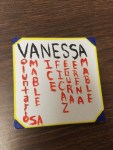 Included below is a great activity that promotes name association with positive personality characteristic traits. Students can work on beginning to identify positive aspects about themselves and work on being able to share them out loud with each other in a classroom setting.
 I’d love for you to share how this activity worked for your students and/or how you modified the activity to make it even better. Drop us a note at
  Graciela Williams “Gracie” is a licensed bilingual school social worker in Annapolis, Maryland. Gracie currently works with newcomer students and runs several social skills groups around the county. She specializes in working with international students who have experienced trauma. She has done extensive work incorporating and facilitating student and parent reunification groups within the school system. Gracie has worked as an Adult ESL teacher and program manager for literacy centers in South Carolina and Colorado. She has a bachelor’s degree in counseling from Bob Jones University and a master’s degree in social work from the University of New England. Gracie is also an Adjunct Professor for Goucher College, where she teaches a graduate level seminar course regarding At Risk Students, and she is an Adjunct Community Faculty for The University of New England providing field instruction to current MSW students.
 these events, students and/or their families typically set up tables to highlight their countries and cultures and the rest of the students and families walk from table to table sampling food and looking at artifacts and maps. While organizers of these events have good intentions and aim to honor their students’ cultural backgrounds, sometimes these events can seem
  tokenistic. How can we build family comfort in schools throughout the school year? With 79% of teachers in the U.S. being white* and 25% of students being children of immigrants, getting to know the cultural backgrounds of students requires a deeper dive.
 There are often two goals of international nights. The first is for students to learn more about other cultures and the second is for teachers to learn more about the backgrounds of their students and their families. With those goals in mind, what are 10 possible alternatives to international night?
 englishlearnerportal.blog